
The Most Dangerous Person in the Room Is the One With Nothing to Lose.
Why She’ll Never Take a Course But Will Trade the Market
I have a family member in her 50s.
She has not worked in over five years. She lives with her mother, who is in her 80s.
She has never dated. Never built a life outside that house. She has 1 friend throughout her years.
She avoids structured programs because they have exams.
Exams are “stressful.”
Feedback is “pressure.”
Deadlines are “too much.”
Yet recently, she enrolled in an online trading webinar.
She even screen-recorded it.
Let that sink in.
The woman who avoids a basic upskilling course is now studying financial markets.
High volatility. High uncertainty. High risk.
Why?
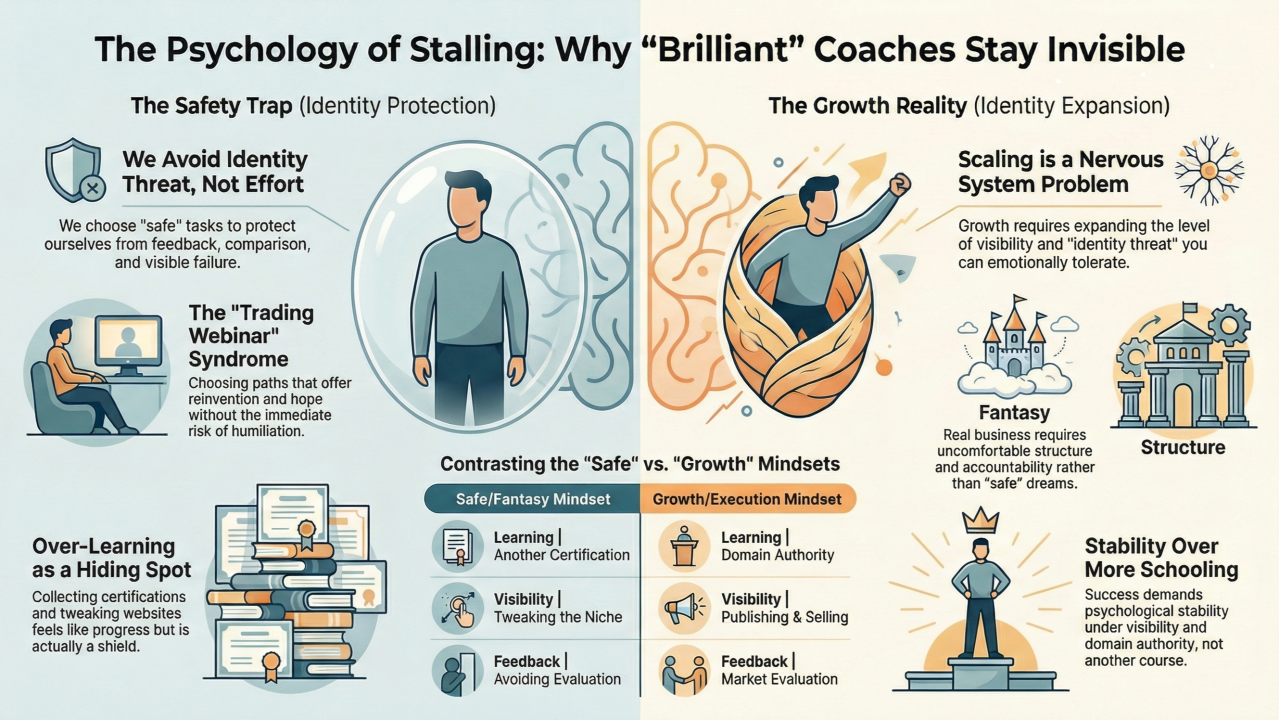
Because trading doesn’t threaten her identity.
Employment does.
The Difference Between Effort and Exposure
Most people think she lacks discipline.
That’s lazy analysis.
She is not avoiding effort.
She is avoiding exposure.
A structured course ends with an evaluation. Evaluation leads to evidence. Evidence can confirm inadequacy.
The nervous system hates that.
Trading, on the other hand, is private.
If she fails, no one knows. If she loses money, she can blame the market. If she quits, she calls it “timing.”
No identity collapse required.
It preserves dignity while offering fantasy.
That combination is psychologically irresistible.
Now Let’s Talk About You
If you are trying to build a coaching practice, scale a therapy business, or step into entrepreneurship, pay attention here!
How many of these feel familiar?
- You keep refining your niche instead of launching.
- You take another certification instead of selling.
- You tweak your website instead of making offers.
- You consume content about marketing strategy but don’t execute.
That is not a lack of capability.
That is identity preservation.
Starting a coaching business exposes you to public measurement:
- Revenue
- Conversion
- Rejection
- Silence
It forces the question: “Am I actually good enough for someone to pay?”
That is far more threatening than learning about trading strategies in private.
The Psychology of Safe Ambition
There is a form of ambition that looks bold but is structurally safe.
It sounds like: “I’m going to trade crypto.” “I’m building something big.” “I’m exploring opportunities.”
But there is no operational plan. No measurable commitment. No public accountability.
It feels visionary.
It is often avoidance.
I say this as someone who holds a Master’s degree in Counselling and works as a Business coach and EMCC ESIA supervisor. I’ve built and scaled ventures in high-pressure environments, including a seven-figure clinic in Singapore’s toughest market.
Execution is never glamorous.
It is repetitive. Visible. Unforgiving.
Fantasy is glamorous.
That’s why it sells.
Trauma, Identity, and Entrepreneurship
When someone has lived small for a long time, their nervous system adapts to smallness.
Predictability feels safe. Expansion feels dangerous.
Even if expansion means freedom.
Entrepreneurship requires identity expansion.
You must see yourself as:
- Valuable
- Competent
- Sellable
- Resilient under rejection
If your internal narrative cannot tolerate that identity, you will unconsciously sabotage growth.
You will choose trading over training. Dreaming over doing. Research over risk.
Not because you’re incapable.
But because your nervous system is protecting you.
Starting a Coaching Practice Is Not a Marketing Exercise
It is an identity shift.
You are no longer:
- The helper hiding behind credentials
- The employee waiting for structure
- The student collecting knowledge
You are the authority.
And authority attracts scrutiny.
This is where many helping professionals stall.
They were trained to serve, not to be seen.
So they remain invisible and call it humility.
The Hard Question
Are you avoiding small, structured discomforts and instead fantasising about big, undefined wins?
My family member may never trade a single dollar.
The webinar gives her something more powerful than income.
It gives her a temporary identity upgrade.
“I’m learning about markets.”
That feels expansive without requiring change.
But sustainable transformation demands friction.
If you are building a coaching practice in 2026 and beyond, understand this:
Your biggest obstacle is not the algorithm. Not market saturation. Not a pricing strategy.
It is the part of you that equates visibility with danger.
The market does not reward potential.
It rewards evidence.
The question is not whether you can dream.
The question is whether you can tolerate being measured.
That is where real entrepreneurship begins.