
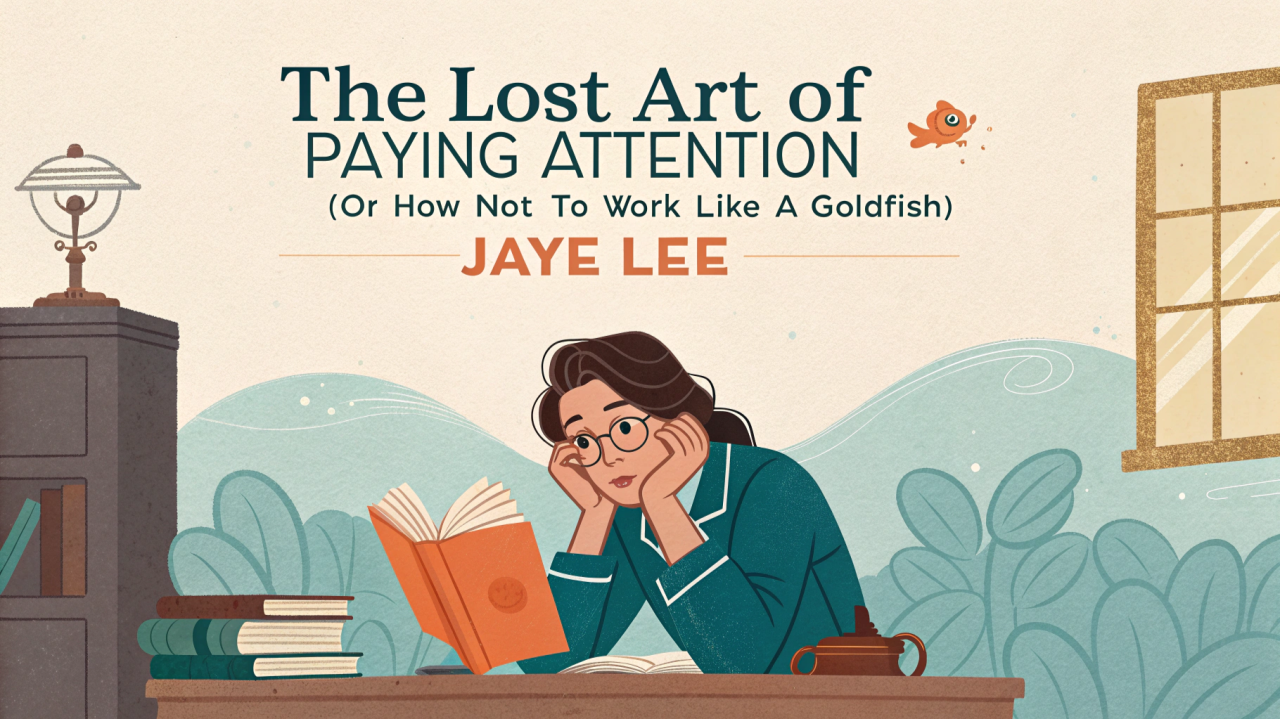
The Lost Art of Paying Attention (Or How Not to Work Like a Goldfish)

Jaye Lee
Business Strategist for Therapists & Coaches | ICF PCC | Scaled 3 Startups | Certified Mentor Coach & Supervisor | CEO Whisperer for the Helping Professions
A No-Nonsense Review of Deep Work by Cal Newport
Have you ever found yourself toggling between 15 tabs, responding to an email while half-listening to a webinar, and oh….. another Slack notification?
Congratulations, you’re officially working like a goldfish! This is exactly why Cal Newport’s Deep Work should be required reading for anyone who’s ever stared blankly at their screen, wondering where the last four hours went.
In a world where productivity is often mistaken for busyness, Newport argues that true success lies in deep work; a state of focused, undistracted, and high-value thinking. Sounds revolutionary, right? Most of us are drowning in a sea of pings, tweets, and never-ending Zoom meetings.
So, let’s cut through the noise and break down what Deep Work teaches me and how I can share it with you how we can apply it without quitting our jobs and moving to a monastery.
Why Deep Work Matters More Than Ever
Newport defines deep work as professional activities performed in a state of distraction-free concentration that pushes our cognitive abilities to their limits. The rewards? Higher productivity, better creativity, and a competitive edge sharper than your boss’s passive-aggressive emails.
The modern workplace isn’t exactly set up for deep work. Between open-office layouts (also known as introvert torture chambers), social media, and colleagues who “just need a minute,” our ability to focus has been reduced to that of a toddler on a sugar high.
Yet, the world’s most successful people from Bill Gates to Elon Musk aren’t just smart. They know how to think deeply. In other words, they don’t just manage time; they manage attention.
So how do we get there?
Strategies to Work Smarter (Not Like a Headless Chicken)
If you’re ready to reclaim your focus and stop working in chaotic bursts of fake productivity, here are some of Newport’s best strategies:
1. Embrace Monastic Productivity (Without Becoming a Hermit)
Newport suggests creating uninterrupted stretches of work by eliminating all distractions. This doesn’t mean we should quit whatever we are doing and and retreating to a cave. It means scheduling deep work like an unmissable meeting with yourself.
Try This:
- Block out 90-minute deep work sessions in your calendar and treat them like sacred rituals.
- Use the “Do Not Disturb” function on everything. Your phone. Your laptop. Your face.
- Tell your colleagues, “I’m in deep work mode” (or if they won’t respect that, tell them you have a mysterious and highly contagious illness).
2. The Shutdown Ritual (Yes, Like an iPhone Restart)
At the end of the workday, Newport recommends a mental shutdown ritual which is a way to close the loop on tasks and signal to your brain that work is done. Because if your brain is still running open tabs like Chrome, you’ll never truly rest.
Try This:
- Write a quick “what’s next” list for the following day.
- Say out loud: “Shutdown complete.” (This may sound weird, but hey, placebo effects are real.)
- Resist the urge to “just check one more email” before bed. It can wait.
3. The Attention Diet (Because Your Brain is Overfed on Junk)
Just like our body can’t thrive on a diet of potato chips and soda, our brain can’t function on a constant stream of low-value distractions. Newport suggests consuming less information but of higher quality.
Try This:
- Unfollow accounts that don’t add value to your professional growth.
- Read long content instead of bite-sized dopamine hits (yes, that means real books).
- Use social media intentionally; not as a reflex when you’re bored.
Stop Confusing Motion with Progress
At the end of the day, being busy is not the same as being productive. In a world addicted to shallow work, those who can master deep work will be the ones who truly stand out.
So if you’ve been feeling like you’re running on a hamster wheel of endless notifications and meetings that should have been emails, it might be time to unsubscribe from the noise and reclaim your focus.
Your real job isn’t to reply to emails faster. It’s to think smarter.
Now, if you’ll excuse me, I’m off to actually focus.
#DeepWork #ProductivityHacks #TimeManagement #EntrepreneurMindset #Focus #WorkSmarter #CareerSuccess #MindsetMatters #HighPerformance #PersonalDevelopment #BusinessGrowth Oneness Consultancy & Academy Vincent Wong Ph.D.