

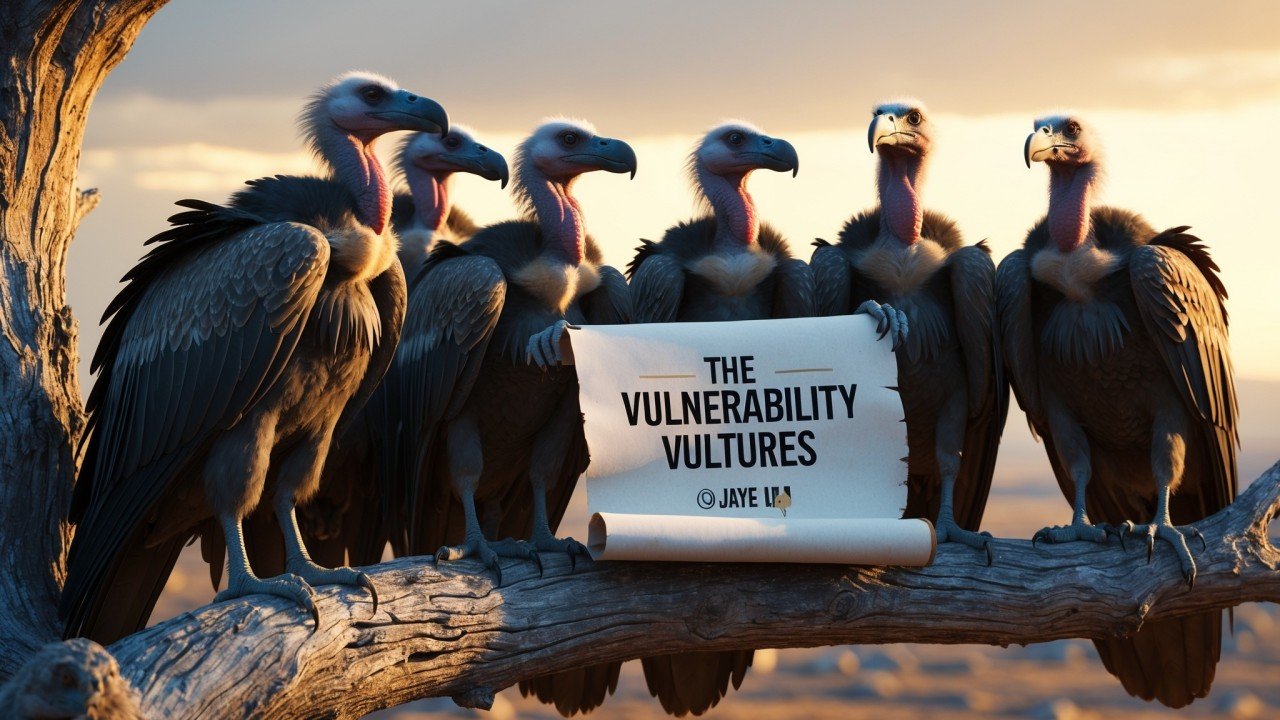
The Vulnerability Vultures
How the Helping Industry Turned Trauma into Content Marketing
Let me paint you a picture from my IG feed this morning:
“Three years ago, I was lying on my bathroom floor at 3 AM, sobbing into a bottle of wine, wondering if life was worth living. Today, I’m helping others find their purpose. Here’s what rock bottom taught me about success……”
7,847 likes. 512 comments. 107 shares.
Welcome to 2025, where your nervous breakdown has become your brand differentiator.
I need to tell you something that’s going to make you squirm:
Your vulnerability has been weaponised.
Your authenticity has been algorithmized.
And your trauma has become content.
It’s time we talked about the Vulnerability Vultures.
The Authenticity Industrial Complex
Somewhere between Brené Brown’s groundbreaking work on vulnerability and today’s social media landscape, we took a wrong turn.
We turned authentic connection into trauma capitalism.
Here’s how the Vulnerability Vulture business model works:
- Have a breakdown (the rawer, the better)
- Document it in real-time (bonus points if you post from the therapist’s office)
- Package the pain into a 3-part social media series
- Perform the healing for public consumption
- Monetise the transformation as “proof” of your offered skills
- Repeat with increasingly dramatic stories
It’s not coaching, therapy, or mentoring. It’s emotional reality TV with a payment processor.
And yes, it gets engagement. Because people love watching train wrecks, especially when they’re dressed up as “inspiration.”
Engagement ≠ business success.
The Neuroscience of Performative Pain
Let’s gear towards the scientific.
Every time you activate a traumatic memory for content, you’re rewiring your brain to associate visibility with suffering.
- You start to believe: “No pain = no content.”
- “No drama = no audience.”
- “No breakdown = no breakthrough.”
And then you panic when your life gets stable.
I’ve supervised entrepreneurs who don’t know how to post when they’re happy.
They’ve forgotten how to create content without crisis.
Their business model? Addicted to chaos.
And their audience? Trauma tourists: people who consume pain for emotional comfort, not clients who want results.
The Engagement Trap: When Likes Become Life Support
Pain-based content performs. Why?
- Schadenfreude: People feel better about their lives when they see yours falling apart
- Emotional rubbernecking: You can’t scroll past a bathroom floor at 3 AM post
- Vicarious catharsis: Others process their trauma through your story
- Comparison comfort: “At least I’m not that broken”
Here’s what high engagement actually delivers:
- An audience of fellow trauma survivors, not paying clients
- DMs from people saying, “Can I tell you my story?” (Spoiler: They don’t want coaching. They want a therapist.)
- Boundary violations disguised as “collaboration”
- A professional reputation based on brokenness, not competence
- Clients who want rescue, not results
I’ve worked with entrepreneurs in the helping industry who had a few multiples of hundreds of thousands of followers than mine and couldn’t pay their rent.
Their engagement was through the roof. Their bank account? Flat on the floor.
The Performance Authenticity Paradox
The most insidious part: Performative vulnerability looks like authenticity.
But it’s the opposite.
Real authenticity is:
- Sharing when it serves the client, not your algorithm
- Being honest about your limits, not your trauma
- Showing up as you are, not as your lowest moment, defines you
- Connecting through shared humanity, not shared damage
Performative authenticity is:
- Calculating which trauma detail will get the most likes
- Scheduling your “raw” post for maximum reach
- Crafting your chaos into a three-act narrative
- Using your pain as a business development strategy
And yes, many started with good intentions. But the dopamine hit of viral vulnerability is addictive.
Before they know it, they’re mining their clients’ sessions for content ideas.
The Client Attraction Catastrophe
When you build your brand on your brokenness, you don’t attract ideal clients. You attract trauma tourists.
What you promise:
- “I’ve been through it so I can help you heal.”
What you deliver:
- A coach who’s emotionally drained, undercharging and attracting people who want free therapy.
I supervised a coach (consent sought for referencing this) whose entire brand was built on her divorce. Every post referenced her ex, custody battle, or financial collapse.
Her audience? Loved it.
Her business? Dead.
Why? Because she attracted people who wanted to talk about divorce drama, not relationship coaching.
She became the divorce story lady, not the relationship expert.
There’s a difference. And it’s the difference between struggling and thriving.
The Trauma Timeline Trap
Social media has created something unprecedented: The pressure to perform your healing in real-time.
Here’s the Trauma Timeline I see again and again:
- Day 1: “I’m going through something hard…” → 868 likes
- Day 15: “It’s worse than I thought, but I’m learning…” → 1392 likes
- Day 30: “The breakthrough is coming…” → 2447 likes
- Day 45: “Here’s what rock bottom taught me…” 3856 likes
- Day 60: “I’m healed and ready to help!” → 4889 likes
See the pattern? The deeper the pain, the higher the engagement.
What this does to actual personal healing: It turns private, messy, non-linear recovery into a public performance.
You start healing for the audience, not for yourself.
The Trauma Olympics: When Pain Becomes a Competition
Welcome to the Trauma Olympics, an unspoken hierarchy where credibility is earned by who suffered the most dramatically.
The unofficial ranking:
- Addiction recovery > Depression
- Childhood trauma > Adult crisis
- Hospitalization > Therapy
- Near-death experience > Emotional pain
- Financial ruin > Relationship issues
I’ve watched coaches unconsciously escalate their stories: From “I struggled with anxiety” → “I had panic attacks” → “I was hospitalised.”
Not because they’re lying. But because more pain = more engagement.
And engagement feels like proof of relevance.
The Supervision Sessions: What Happens Behind the Posts
As a supervisor, I hear the real story after the post goes viral.
Here are the monthly confessions:
“I shared something personal and got amazing engagement… but I feel exposed.” → Translation: I confused marketing with therapy.
“People keep DMing me their trauma stories.” → Translation: I attracted trauma tourists, not clients.
“I feel pressure to keep sharing deeper stuff to maintain engagement.” → Translation: I’m addicted to the dopamine hit of vulnerability.
“My business is slow, but my anxiety about posting is high.” → Translation: My marketing strategy is at war with my mental health.
“I don’t know how to post without talking about my struggles.” → Translation: I’ve tied my professional value to my pain.
These aren’t flaws. They’re symptoms of a broken system.
The Business Model Breakdown
Let’s talk economics because the numbers don’t lie.
Vulnerability-based businesses have fatal flaws:
- Revenue ceiling: When your brand is your brokenness, success feels like betrayal.
- Client quality: Trauma-bonded audiences rarely pay premium rates.
- Emotional labour: Every interaction becomes therapy.
- Sustainability: You can’t mine trauma forever.
- Reputation: Being known for your problems limits your perceived competence.
I’ve worked with coaches who couldn’t fill a HKD$880 workshop despite 50K followers.
Why? Because their audience loved their pain… but wouldn’t pay for their expertise.
The Algorithm Amplification Effect
Social media rewards pain. It’s that simple.
The cycle:
- Share vulnerable post → High engagement
- Algorithm rewards it → More reach
- You feel “seen” → Dopamine hit
- Repeat with more drama
- Your professional identity becomes your trauma
The most “successful” vultures aren’t the most healed. They’re the best storytellers of suffering.
The Gender Trap: Why Women Are Targeted
Women are disproportionately affected.
Why? Because society tells women:
- “Be warm, be relatable, be vulnerable.”
- “Don’t be too professional, you’ll seem cold.”
So they lead with pain to prove they’re “authentic.”
But then they get:
- Empathy, not respect
- Connection, not compensation
- Free/ probono session requests, not paying clients
It’s a double bind: Too professional = “cold”
Too vulnerable = “needy”
And the industry rewards the latter.
The Trauma Content Creation Cycle
Here’s the predictable pattern I see:
- Crisis happens → Natural to share
- Engagement soars → Brain says, “This works!”
- Pain becomes content → Stories get amplified
- Healing becomes performance → Recovery on a deadline
- Stability = content scarcity → Panic sets in
- Unconscious drama-seeking → To maintain relevance
It’s not a business model. It’s a psychological trap.
The Authenticity Audit: Are You a Vulnerability Vulture?
Ask yourself:
- Do you schedule your vulnerable posts for maximum reach?
- Do you mine therapy sessions for content ideas?
- Do you exaggerate details to make stories more compelling?
- Do you feel anxiety when life gets stable?
- Do you attract free therapy seekers, not paying clients?
- Do you feel drained after posting?
- Can you describe your value without referencing trauma?
If you answered “yes” to more than two, you’re in the vulture zone.
The Client Experience: What It’s Like to Work with a Vulture
I’ve spoken to clients who said:
“I hired her because her vulnerability seemed real. But every session turned into her processing her stuff. I felt like I was paying to be her therapist.”
That’s not coaching. That’s boundary collapse.
How to Break Free
Step 1: Content Detox
- 30-day moratorium on personal story sharing
- Audit your content: How many leads with pain?
- Redefine your professional value
Step 2: Audience Analysis
- Who’s engaging vs. who’s paying?
- Who’s seeking therapy vs. transformation?
Step 3: Reposition
- Lead with solutions, not stories
- Market outcomes, not obstacles
Step 4: Build Systems
- Create frameworks that don’t depend on your emotional state
- Price based on value, not guilt
Step 5: Sustainable Authenticity
- Share when it serves, not when it sells
- Be human without performing humanity
The Economics of Expertise vs. Empathy
Empathy doesn’t scale. Expertise does.
- Empathy-based coaches: Struggle to charge, attract free-seekers, burn out
- Expertise-based coaches: Charge premium rates, attract serious clients, scale
The difference? Business model.
The Content Strategy Revolution
Instead of:
“How my trauma taught me resilience”
Try:
“3 evidence-based strategies to build resilience”
Instead of:
“My divorce story”
Try:
“How to navigate relationship conflict with clarity”
One leads with pain. The other leads with power.
The Future of Authenticity
The future belongs to those who:
- Build competence, not just content
- Solve specific problems, not general pain
- Charge fairly, not guiltily
- Market solutions, not sob stories
- Measure results, not resonance
The Uncomfortable Questions
Before you post your next “raw” moment, ask:
- Am I sharing to serve or to get engagement?
- Would I share this if no one was watching?
- Am I using my pain as a qualification?
- Does this position me as competent or just relatable?
- Am I healing for myself or performing for others?
Your answers will tell you everything.
Your Next Strategic Move
If this hit a nerve (and it should), here’s your path:
- Audit your last 20 posts → How many lead with pain?
- Take a 30-day break from personal story sharing
- Rebuild your brand on competence, not catastrophe
- Raise your rates based on value, not vulnerability
The Call to Professional Evolution
It’s time to grow up.
Stop conflating authenticity with oversharing.
Stop confusing healing with helping.
Stop building businesses on catastrophe.
Your healing is sacred. Your business should be strategic.
The most authentic thing you can do?
Stop performing authenticity and start delivering results.
Ready to Transform?
I’ve created two resources to help you make the shift:
🎯 FREE 90-Day Practice Transformation Blueprint: A step-by-step guide to building a competence-based practice.
📞 FREE 30-Minute Business Audit Call I’ll analyse what’s actually working in your business -no sales, no pitch.
👉 Add me to your Linkedin Connection + Comment “BRAND” to get both.
The vulnerability vultures are circling. The question is: Are you one of them… or are you ready to build something real?
Your trauma story got you into this work. Your professional competence will determine whether you can afford to stay.
Choose authenticity. Choose competence. Choose sustainability.
Your clients and your bank account will thank you.
What’s the most uncomfortable truth in this article for you? The one that made you squirm? Hit reply. I read every response and your insights often become the foundation for future pieces.
And if you know someone stuck in the vulnerability vulture cycle, share this. Sometimes the most loving thing you can do is hold up a mirror.